The answer to life, the universe and the Perfect Aeropress Recipe
James Hoffman, if this ever gets to you, thank you for doing what you do!
Intro
Consider the sentences – She found her home, he found a wife, find your passion. Would you agree that these sentences represent some of the most significant events in a person’s life?
Notice the verb in all of them: to find, which implies that the person was looking for the things they found. Life is a search problem, and none of us knows what we are searching for; we know it when we find it.
The AeroPress Championship (how did I get here?)
My soon-to-be wife wanted good coffee at home, and so, she planted a seed in me through gifts (The World Atlas of Coffee by James Hoffman, an AeroPress, etc) and kept watering it. Four years later, I had found myself a new obsession, measuring water temperature, freaking out about grind size, etc. Damn you, little butterfly!
Driven by that obsession, I decided to sign up for a regional AeroPress competition (there are three levels: regional, if you qualify, you go to the national competition, if you win, you go to the international championship).
The Mechanics
Ten days before the event, the organisers send every participant a sample of the competition coffee (the same for everyone). Our mission is to find the ideal AeroPress recipe that we will prepare for the judges on the day of the event.
And to be honest with you, this was the part I enjoyed the most. As I said at the start, life is a search problem, and in a way, being happy means enjoying the journey to its answers. Because, for all we know, the answer itself might be 42. In this case, a pair of numbers—one for temperature and one for grind size.
The Recipe
When I received the coffee, my first thought was: how are you going to find a recipe if you have the taste buds of a catfish? My impostor syndrome loves hyperbole, but sometimes, it does point in the right direction. With that question in mind, I decided to do this in the best way I know how, using data.
A good cup of coffee
At its core, making coffee is dissolving coffee in water. Making good coffee consists of dissolving, mostly, the nice parts of the coffee. And as with any solution, we have some variables in our control. Depending on the machine we use, we can control the temperature of the water, the grind size of the coffee, pressure, contact time, etc.
The Experiment
To keep it simple, I chose to experiment with the two variables that make the most difference (grind size and temperature) and keep the rest equal. I chose two temperatures (90 and 95 degrees) and three grind sizes (for those with a Comandante at home: 25, 35 and 45 clicks). This gave me six different recipes that I conveniently named after the characters of Friends:
- Joey: 25 clicks, 90 degrees
- Chandler: 35 clicks, 90 degrees
- Monica: 45 clicks, 90 degrees
- Ross: 25 clicks, 95 degrees
- Phoebe: 35 clicks, 95 degrees
- Rachel: 45 clicks, 95 degrees
Once I had decided on the settings, I invited some friends over for a coffee testing afternoon. Each one of them would be presented with a head-to-head (randomly assigned) of two coffees, and their job was to say which one they liked the most. Each person judged six random head-to-heads, twice. The goal was for me to collect their answers and build a ranking.
How do we find the best recipe?
Well, the same way you would find the answer to life, the universe and everything: step by step. In life, you cannot find meaning without experience. Think about the hundreds of things you’ve had to try before locking into the few things that bring you joy.
When you try something, that experience tells you which direction to go; if you like it, you continue in the same direction. If you hated it, you turn around. And you do the same with the next experience, and the one after that and so on. And if you are lucky, you become a surfer, because you realise that the search is the actual point.
What??
Sorry about that! I just let go for a second. Now, this might be a bit much if you came for coffee, not chess, but bear with me. I used the Elo rating system (if you know what it is, skip ahead). Elo is a rating system used, for instance, to rank chess players. It tries to assess the underlying ability of players based only on the results of their head-to-head matches.
In my coffee experiment, every head-to-head represents a match, and every recipe is a player. All recipes start with the same rating: 1,500. After each head-to-head, the rating of each recipe gets updated using the following formula:
K is a constant that we choose; if K is too high, then each head-to-head will change the rating of the recipes considerably. If K is too small, then each head-to-head will change the rating only very slightly. I chose 42, which is considered reasonably high, because I am not a man of many friends; hence, the sample size (number of head-to-heads) is small, and I needed the rating to converge relatively quickly.
S is the result of the head-to-head (1 if the recipe wins, 0 if it loses).
Finally, E is the result I would expect based on the strength of the recipe and the strength of its opponent.
If a recipe performs better than expected, its rating jumps. If it underperforms, it drops. Over time, this nudges each recipe’s rating toward its “true” appeal.
The Results
After all the head-to-heads were completed, the ratings converged to give a clear winner.
In the chart below, each timestamp (the horizontal axis) represents one round (6 head-to-heads). The 5 of us did 2 rounds each. The vertical axis is the Elo Score of each coffee after each round.
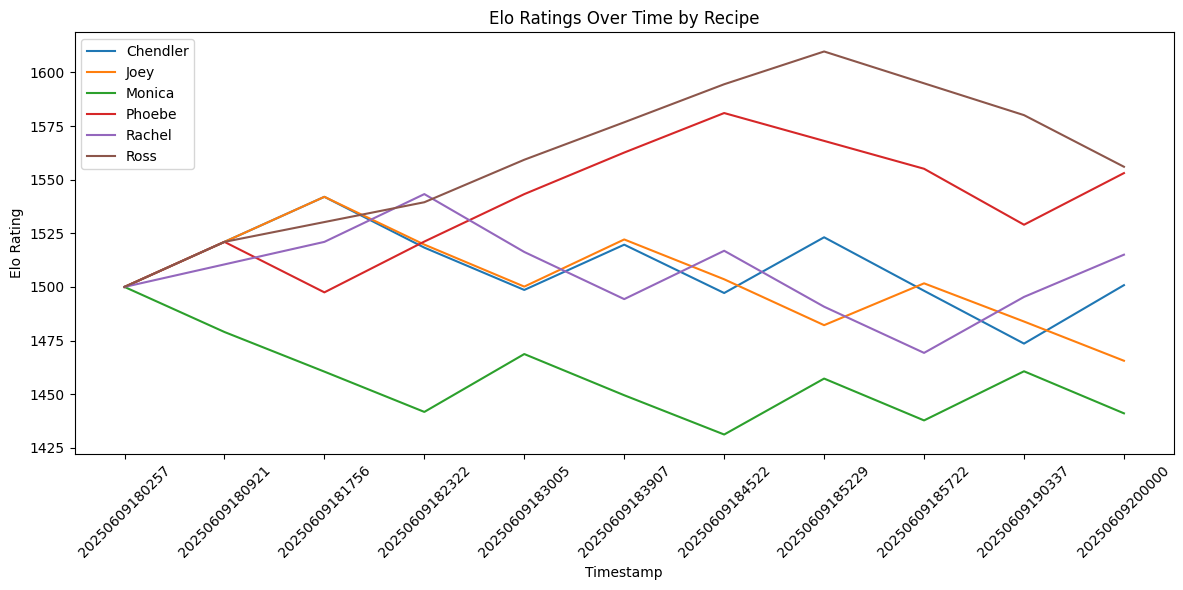 The recipes with the highest extraction (highest temperature and lowest grind size), Ross and Phoebe, are the favourites. The one with the lowest extraction, Monica, was the least favourite.
After seeing the results, I adjusted the winner recipe to my liking (27 clicks for grind size and 92 degrees for the water) and headed to the competition.
So, did you win?
I got knocked out in the first round (of three). You see, I travelled the universe, I went to Norway and dined at the restaurant at the end of the galaxy. I got lost in prehistoric Earth with my friend Ford Prefect, and there, a prehistoric woman spelt 42 with rocks and laughed at my face. But honestly, I wouldn’t have had it any other way.
Final Recipe
- Grind Size: 27 clicks (Comandante)
- Water Temperature: 92 degrees
- Method: Inverted AeroPress
- Ratio: 14g Coffee / 230g Water
- Bloom time: 40s with 40g of water